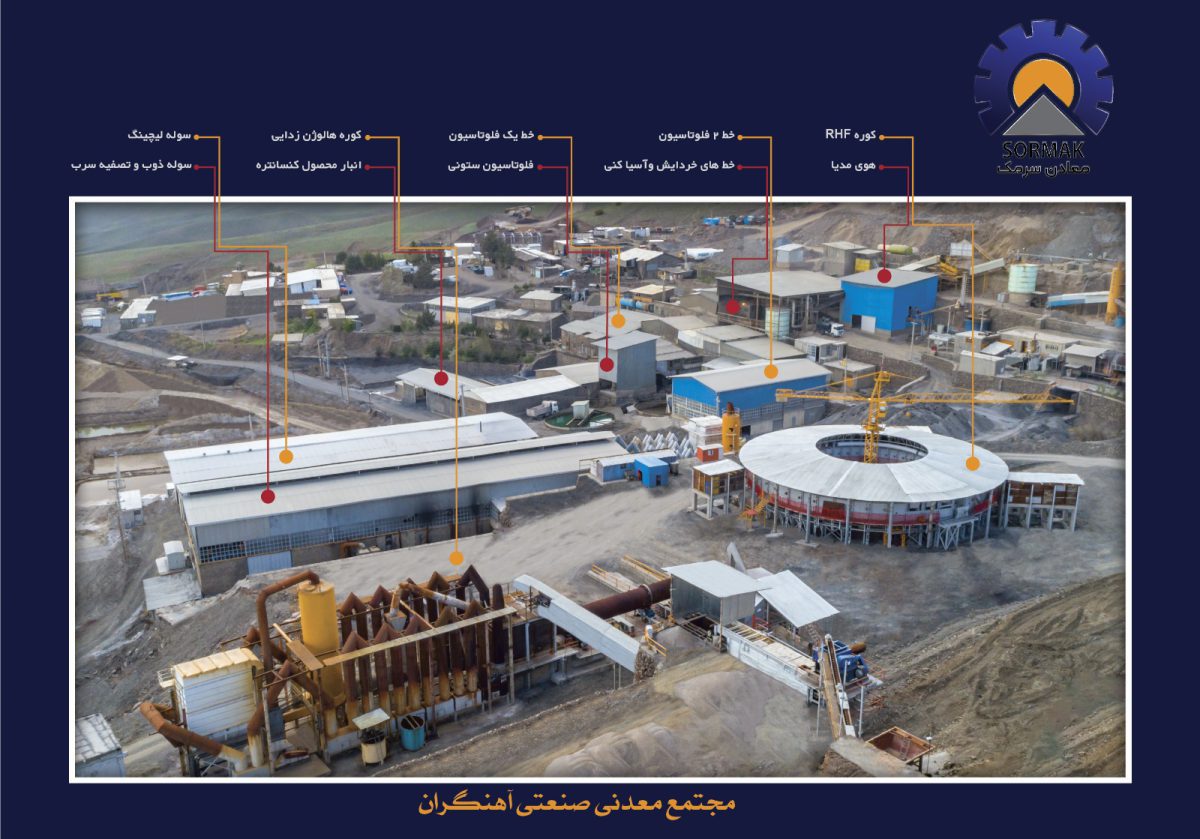
Lead, Zinc, and Copper Flotation Plant
The flotation plant of Sarmak Mining Company was built in 1973 by France with a capacity of 150 tons per day. Over time, and considering the discovery of new lead reserves in the Angouran mine and changes in global prices of produced concentrate, the company, relying on its expert and experienced workforce, increased its capacity.
Currently, this plant has the ability to float approximately 500 tons of input feed daily. Additionally, in 2019, the company established a second flotation plant to increase the plant's capacity to one thousand tons of input feed, which was done by the company's personnel. These two lines together are capable of floating approximately 1500 tons of input feed daily. It is worth mentioning that this plant is capable of floating fine tailings from previous years, and approximately 80% of the plant's feed is supplied from the tailings dam of previous years.
This company is the first in the field of importing and localizing column flotation cells with modern technology in the field of producing fine air bubbles by means of a special type of sparger, which is capable of floating input feed with higher efficiency compared to mechanical cells.
The flotation plant includes crushing, grinding, and flotation sections, and the main input feed of the plant is the ore extracted from the Angouran mine. The company has two independent crushing lines, the equipment of which includes various classifying screens, feeders, jaw crushers, cone crushers, and ball mills with different sizes and capacities, along with classifying cyclones.
In the crushing and grinding section, the input feed is first crushed by jaw crushers and conveyed by conveyor belts onto a classifying screen. The fraction below 12 mm is directed into the mill bunker, and the material above 12 mm is directed into the cone crusher, and after that, by returning to the screen and continuing the cycle, it is directed into the mill bunker.
After milling and reaching the desired dimensions, the material is classified by cyclones, and the underflow of the cyclone is directed back into the mill. The overflow of the cyclones enters the flotation preparation tanks, where various chemicals such as frothers, collectors and auxiliary collectors, depressants and activators (such as pine oil, potassium amyl xanthate, and sodium sulfide, etc.) are prepared, and the pulp enters the flotation cells. In this plant, various stages of primary flotation (rougher), concentrate scavenging, and concentrate washing (cleaner) exist in several stages, and it is the only plant of its kind that allows flotation and production of four types of carbonated and sulfide lead and zinc concentrates independently.
Mechanized Natural Asphalt Powder Production Plant and its Processing Activities:
Sarmak Mining Company is one of the largest producers of natural asphalt (gilsonite) in Iran. For this purpose, the company has carried out various activities, including the construction of three mechanized powder production lines and performing many processes to reduce ash and increase the purity of this valuable mineral material such as flotation.
The natural asphalt processing plant is located in the Bisotun area of Kermanshah province, next to the main road, and has suitable facilities and equipment for micronizing natural asphalt with three crushing and powdering lines, including Raymond mill equipment and packaging equipment in 25 kg bags and in jumbo bags and palletizing (along with strapping, shrinking, and cardboard plastic flooring and roofing), and is also equipped with up-to-date dust collection, dehumidification, and ash reduction systems. This plant has an annual production capacity of 30,000 tons of micronized powder and is packaged in 25 kg jumbo bags.
Heavy Media Separation System:
Sarmak Mining Company is one of the first companies in Iran to use heavy media separation and concentration systems. The heavy media system is a gravity separation method in which heavy media are produced by ferrosilicon, and inside the heavy media hydrocyclone, heavy and light particles are separable based on centrifugal force and also the difference in specific gravity. Among the advantages of the heavy media method are relatively high capacity, low operating cost, high efficiency, good enrichment ratio, no use of chemicals, and being environmentally friendly.
Mineral Materials Laboratory Unit:
Considering the vast field of mining at Sarmak Mining Company, the need for a laboratory is inevitable. Therefore, the company has been active in the field of chemical analysis of mineral materials for years and is currently equipped with advanced and up-to-date chemical analysis devices, including Atomic Absorption Spectrometer, XRD and ICP, and has obtained the necessary approvals in this field, including ISO17025 certification (quality management certification in the laboratory). The company also performs processing experiments on a laboratory scale, jig, magnetic table, and flotation.
Mineral Asphalt Laboratory:
This company has a well-equipped laboratory for analyzing and testing natural asphalt to determine the amount of ash, moisture, various asphalt solubility, and grain size, and has obtained the necessary approvals in this field, including ISO17025 certification (quality management certification in the laboratory).
Design, Manufacturing, and Installation of Crushing and Processing Equipment for Mineral Materials:
This company has the ability to design and manufacture various mechanical flotation cells, JIGs, columns, mixers, pumps, screw conveyors, bag filters, Raymond mills, various mills, and mineral processing lines.