Attached File
Click The Link Below To Download The PDF File
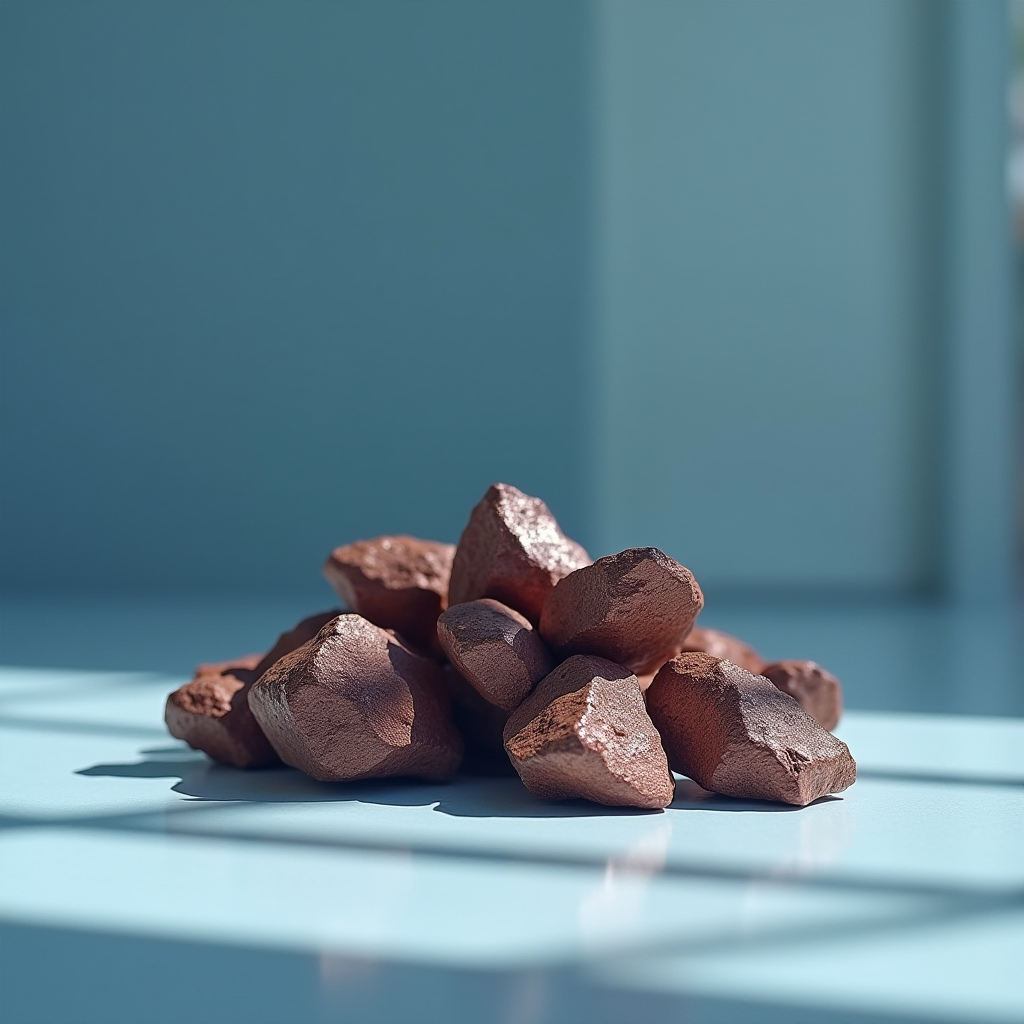
The iron ore produced by Sarmak Company is in the form of hematite and is extracted from the Ahangaran mine in Malayer and is very suitable for use in the cement industry. For this purpose, the produced iron ore is offered in two ranges (0-40) mm and (0-300) mm. In the past 30 years, more than 25 major cement producers in Iran have been buyers of iron ore from Sarmak Mining Company, including Sepahan Cement, Behbahan, Karun, Ramhormoz, Nahavand, Saman Gharb, Hegmatan, Gharb, Ekbatan, Fars, Saveh, Dorood, Zanjan, Kurdistan, etc.
It should be noted that the iron ore of Sarmak Mining Company is of low-grade hematite type and is only used in the cement industry of the country.
The proven reserve of Ahangaran iron ore mine, which is mostly hematite, is about 11 million tons with an average grade of 35%, of which 500,000 tons can be extracted annually.
The production method is that the lumps are extracted directly from the mine with the great efforts of experienced workers and technical experts in the field of geology, exploration and extraction, and after crushing to a certain extent, it is directly offered to the market, which creates employment for more than 200 hardworking personnel and employment of about 100 trailer drivers to transport to the cement factories of the country, and we are proud that with the grace of God Almighty, as a powerful arm for the cement industry, relying on the efforts and efforts of caring managers and hardworking personnel and using technical and engineering knowledge, we have achieved this important goal.
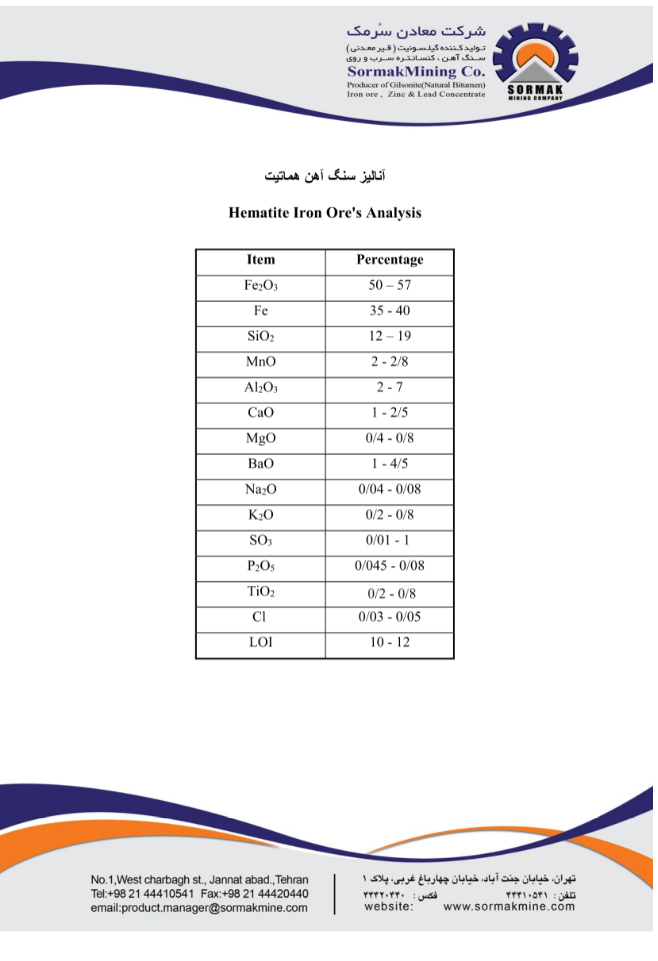
The analysis of Sarmak Mining Company's iron ore can be seen below.
Iron ore is a type of mineral rock that contains the metal iron with the chemical symbol Fe. The iron ore found in different mines is different in terms of appearance and internal structure and is composed of different minerals, but the most important of them are magnetite and hematite.
Iron ore is the most important raw material for the production of iron and steel. In general, the major part of iron ore is used in the traditional method of iron and steel production (blast furnace / converter) and only a small part of it is used in other methods, especially direct reduction, so that of the total amount of iron ore that is extracted in the world, less than 10% is used for direct reduction and more than 90% is used in blast furnaces..
The specifications required for iron ore vary depending on the type of consumption and the region of production and preparation. For example, an iron ore that can be used well in the traditional method may not be usable at all in direct reduction methods, or the specifications required for the consumption of red soil in paint making are completely different from its metallurgical uses. Thus, it is observed that not only the specifications required for iron ore in different uses and also different points are not the same, even in the case of each blast furnace or direct reduction method, the specifications of iron ore must be compatible with the type of furnace, capacity, height, etc. The following table shows the main materials needed to produce one ton of steel..
Main raw materials required per ton of steel
Raw material | Amount per ton of steel | Remarks and place of consumption |
Iron ore | ۱۵۰۰ to ۲۰۰۰ kg |
|
Coke | ۴۰۰ to ۵۰۰ kg | In blast furnace and traditional method |
Iron ore | ۱۰۰ to ۲۰۰ kg | In blast furnace and production of self-fluxing pellets |
Air | ۱۹۰۰ to ۲۰۰۰ kg | In blast furnace |
Additives such as bentonite | ۱۰ to ۵۰ kg | In pelletizing |
Oxygen | ۴۰ to ۵۰ cubic meters | In steelmaking from pig iron (converter) |
Natural gas | ۱۰۰ to ۱۲۰ cubic meters | In blast furnace |
Natural gas | ۳۰۰ to ۷۰۰ cubic meters | In direct reduction depending on the type of method |
Electrical energy | ۵۰۰ to ۶۰۰ kilowatts | In steelmaking from sponge iron In electric arc furnace |
Energy | ۱/۵ to ۳ million kilowatts | Pellet production and baking |
Energy | ۰/۳ to ۰/۵ million kilocalories | Lump baking |
Water | ۷۰ to ۸۰ cubic meters |
|
Refractory | ۳۰ to ۵۰ kg | Depending on the type of method |
The specifications of each of the raw materials shown in the table depend on the type of method and factors, and only the specifications related to iron ore will be discussed in this section..
The use of iron ore for the production of iron and steel usually takes one of the following forms::
Granulated iron ore
Granulated iron ore is less used today. The reason for this can be justified by its low reducibility. In any case, for the consumption of iron ore directly in the preparation of iron, its dimensions must be completely specified..
Iron ore in the form of lumps
Lumping is the most common method of using iron ore. Every year, about 700 million tons of lumps are produced and consumed in the iron and steel production industries..
Iron ore in the form of pellets
The production of pellets is currently about 300 million tons per year, of which more than 80% is consumed in blast furnaces and the rest in direct reduction. It is obvious that the specifications of the pellets are different for use in each of the methods