Attached File
Click The Link Below To Download The PDF File
Other names and pronunciations in Persian and Arabic
Gilsonite (Jilsonite, Zhilsonite, Jilsonite, Zhilsonite, Natural Bitumen, Mineral Bitumen, Bitumen, Asphaltum, Natural Asphalt)
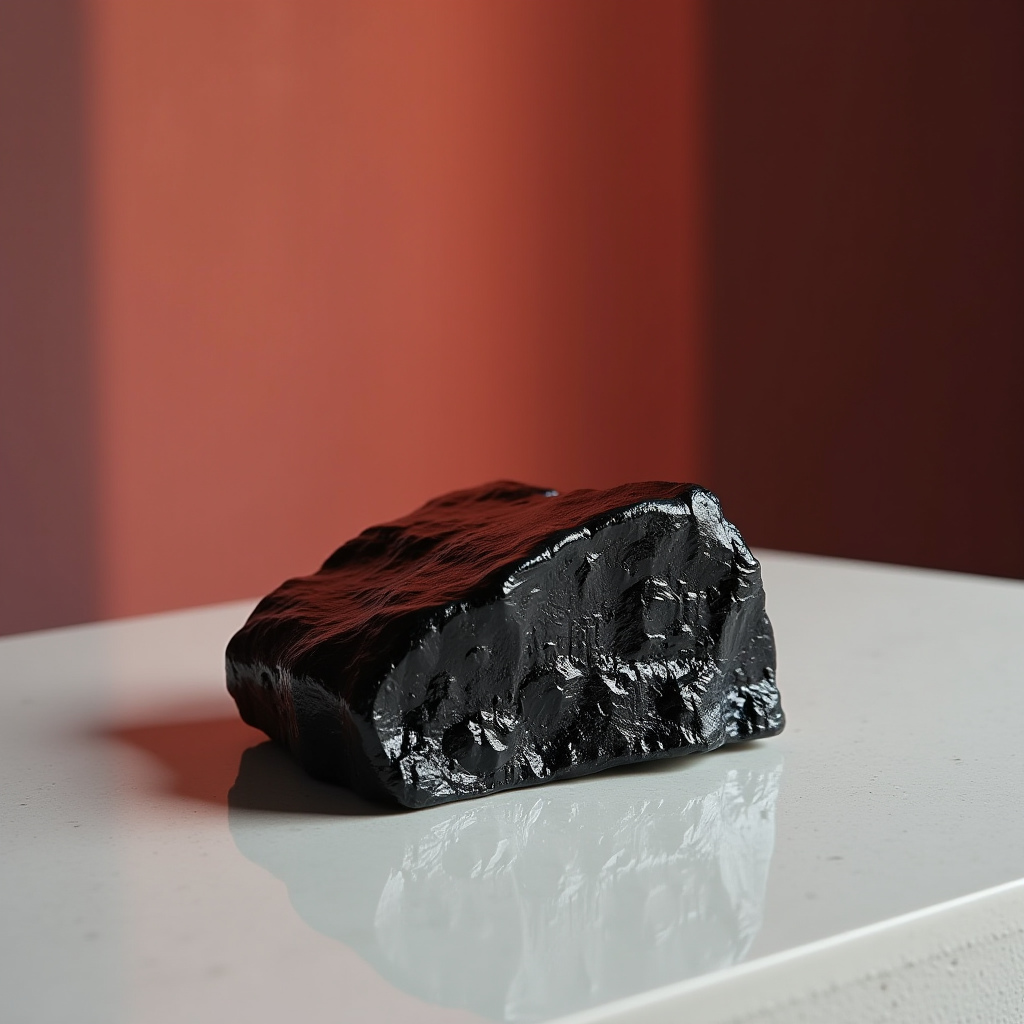
Gilsonite is a solid, brittle, shiny material with high luster. In terms of physical and chemical appearance, it is similar to coal (fossil fuels) and bitumen (petroleum products). Its main difference with coal is its softness and melting before burning. Also, its main difference with bitumen is its hardness and the properties of its polar molecules, which give it dispersing properties. The fundamental difference between Gilsonite and natural and synthetic hydrocarbon minerals has made it used in most applied industries as a unique mineral in terms of physical and chemical properties. Gilsonite is divided into three grades: ordinary, sorted, and screened. This classification is based on the melting point, their refractive index, and the amount of fine particles.
Geographically, this valuable and practical material was first discovered in the Utah region of the United States, as well as in western Iran in the provinces of Kermanshah and Ilam, and its durability is greater than that of petroleum bitumens. Such bitumen may exist in pure form in nature (lake bitumen), such as the Behbahan bitumen lake in Iran and the Trinidad bitumen lake in the United States, or it may be extracted from mines (mineral bitumen).
Considering the long-term experiences of this company in the field of exploration and extraction of minerals, as well as the production and processing of natural bitumen, it should be noted that this company is the first producer of natural bitumen in lump form from the Graveh mine in the Ghasr-e Shirin area of Kermanshah (1953), and powdered bitumen in size (40 -) mesh was produced for the production of bitumen products such as enamel, primer and mastic in the production unit located in Bisotun, Kermanshah (1961), and with the efforts of the engineers of the research and development department of this company, it succeeded in designing, manufacturing, installing and commissioning 2 Raymond lines, the result of which was the production of micronized powder in size (200 -) mesh in the year (1991) and the system of reducing moisture and ash in the produced powder, and considering the use of the latest bagging and packaging technology and quality control of production in this field, it has succeeded in obtaining the title of the model producer, processor and exporter for 7 consecutive years. Also, by benefiting from a large mechanized system for underground explorations, it has become the model operator and main exporter in the country for the last 15 years. Currently, the production capacity of this mineral is about 8,000 tons in bulk and 6,000 tons of micronized powder per year, most of which is used by bitumen and waterproofing factories.
To buy the highest quality and purest lumps or mineral bitumen powder, contact us. The selling price depends on the amount of purity (grade), granulation or mesh size, and type of packaging (bulk, bag, jumbo bag).
We are ready to offer this product to domestic factories and consumers, including the oil industry, as well as close cooperation with dear traders and exporters for export to target countries.
1- In lump form
2- As a powder of size 40- mesh
3- As a powder of size 200- mesh
4- Granulation can be done according to customer's request.
1- The standard packaging of this company for powder is one-ton jumbo bags.
2- If requested, packaging is done in 25 kg laminate bags.
3- Packaging is available according to customer's request (strapping and palletizing, stretch shrink).
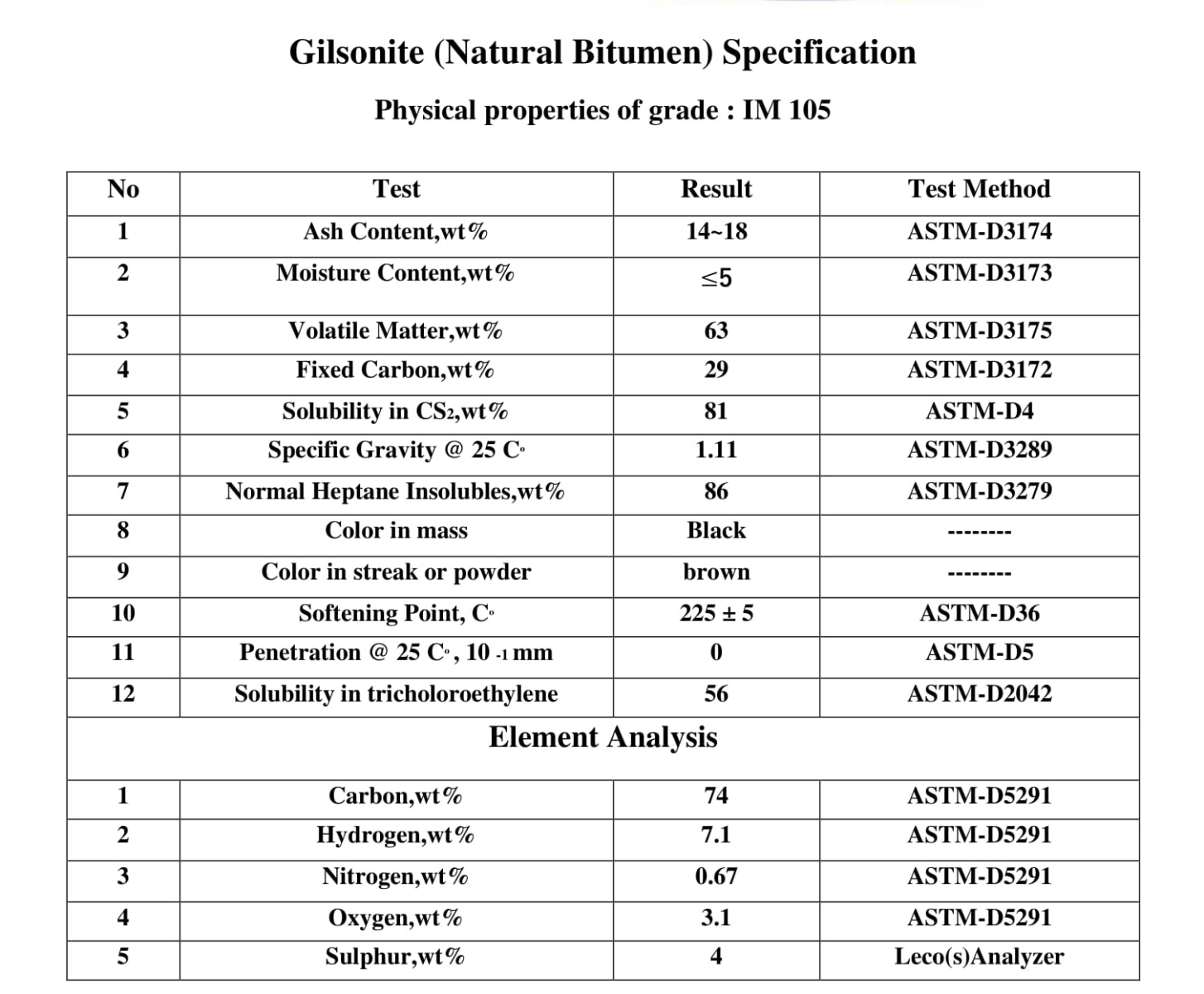
1- As per the attached analysis.
2- The analyses are according to the standard (ASTM D482; ASTM D2042; ASTM D3142; ASTM D3174)
3- Sampling and analysis will be done by the inspection company (SGS), at the factory or Bandar Abbas.
1- 200 tons of lumps are delivered daily at the mine or Bandar Abbas
2- 100 tons of powder are delivered daily at the factory or Bandar Abbas
You can see the location of our mine and factory in Google earth.
Factory Location
38 (IRAN)
34° 22́ 18.96" N
47° 25́ 30.58" E
Mine Location
38 (IRAN)
34° 27́ 46.36" N
45° 40́ 58.76" E
Advantages of using Gilsonite in the production of waterproofing and asphalt:
Since Gilsonite is highly water-repellent and resistant to acids and bases, it is generally used in the preparation of asphalt and waterproofing. One of the prominent features of Gilsonite materials is their solubility in non-polar solvents such as carbon disulfide and toluene, as well as molten bitumen. This feature of Gilsonite is used in the industries of waterproofing and moisture insulation.
Due to its polymeric hydrocarbon materials, Gilsonite is considered a suitable modifier for refinery bitumens used for asphalt and waterproofing. Gilsonite also reduces the penetration degree, increases viscosity, increases softening point, and increases the thermal resistance of refinery bitumens.
Gilsonite is used as an efficiency-enhancing agent in asphalt mixes. Asphalt mixed with high-grade Gilsonite becomes completely integrated without the need for other modifier materials that are added to asphalt in powder form.
Gilsonite can replace "SBS" polymers in asphalt modifiers in whole or in part, or as a supplement, in terms of value and price. Gilsonite-modified asphalts have higher stability, less deformation, lower temperature capability, and greater resistance to water, and less permeability than asphalts not mixed with Gilsonite.
Gilsonite is used as a preservative in hot mix paving. Modified mixtures increase the stability of the pavement. In fact, the main function of Gilsonite in this application is to improve the stability of the pavement and its resistance to deformation, which increases the load-bearing capacity and is used in areas under high pressure and stress. More than 10% of asphalt road pavements in the United States that have been studied are high-pressure surfaces, and modifiers such as Gilsonite have been used in about a few percent of these roads.
Also, the sulfur and sulfur compounds in Gilsonite also increase the strength and resistance of asphalt. Perhaps it can be said that one of the main applications of Gilsonite in Iran is this case, considering the efforts of this company as the flagship of natural bitumen production in the country, God willing, in the near future, we will witness the use of this valuable mineral in the streets and roads of our beloved country.
Gilsonite analysis: